The Refinement Layer : Audit — Tune — Change
Greetings,
I hope you are doing well.
The next module for the breakdown of Solo-Social System is the “Refinement” Layer. The Refinement Layer is the mechanism designed for calibration. If the Execution Layer is the engine that drives action, and the Reflection Layer is the mirror that reveals results, the Refinement Layer is the toolkit used to tune the system for peak performance.
Refinement is not merely about trying new things or acting blindly; it is about “nuance.” To refine is to improve by adjusting minute details rather than overhauling the entire system. This layer relies heavily on the data gathered from your previous execution and reflection. Without understanding the specific context of why a habit failed or succeeded, you cannot effectively refine it.
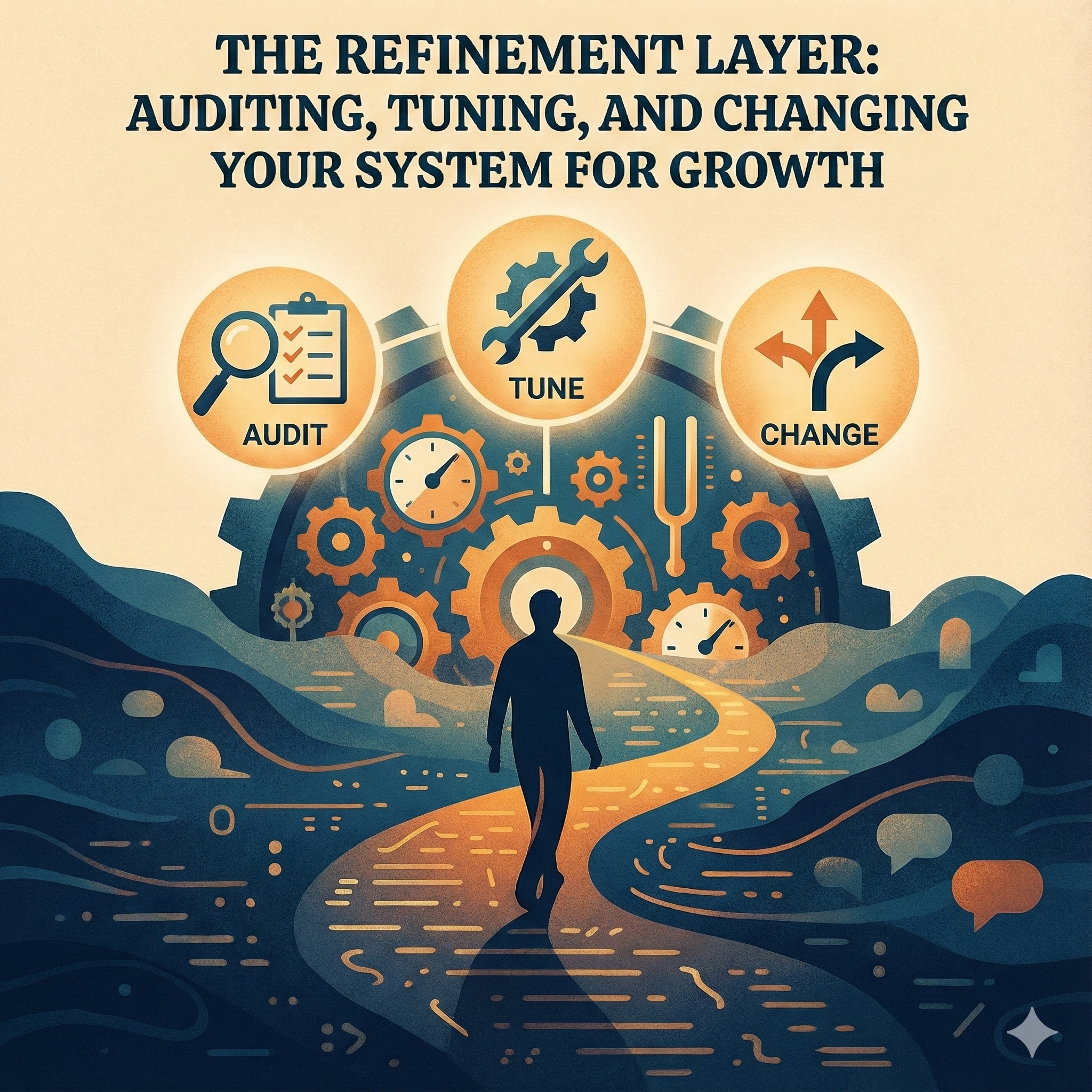
In practice, this layer transforms raw data into actionable evolution. It functions through a cycle of three distinct but interconnected activities: Audit, Tune, and Change.
Audit The System
The first step of the Refinement Layer is Auditing. Auditing simply utilizes aspects from the reflection and execution layers to identify progress markers. For example, the journal from the reflection layer, combined with the routine and operations breakdown from the execution layer, can illustrate daily progress and activities. This combined document — including journal-based reflection and trackers for tasks and habits — can be analyzed to find patterns and gaps.
Understanding these patterns and gaps is the essence of auditing in the refinement layer. Another requirement for auditing is to understand context and alignment. For example, the document can help us understand what is being done and what is not, but without alignment or context, we will not know the effect of that situation on our growth. Similarly, the system design is based on primary alignment over goals to fuel continuous iterative growth for an individual.
In practice, auditing should be done at a specified frequency to optimize the process and growth. This is not just for understanding, but also to facilitate change. In my experience, weekly auditing provides enough time for the system to take effect and for missed actions to be analyzed properly. It also provides space for change, allowing the previous audit to serve as a comparative data point.
Tune The Way
After auditing comes tuning. Tuning is similar to refinement, as it is also based on making small changes. “Tuning” is generally used in the context of musical instruments and car engines. While you may initially wonder how it fits into the refinement layer, it is a deliberate metaphorical use of the term.
The reason I use “tuning” is due to my familiarity with the word, and the fact that each habit, task, or action is an instrument or engine in itself. After auditing, you may not need to completely replace or improve a habit, but rather “tune” it slightly to see if a new configuration works better or worse. Moreover, tuning may last the entire audit and improvement period, as it requires regular testing and verification.
For example, if you realize one of the actions in your execution layer — or a specific insight from the reflection layer — is affecting the system negatively, you can try different tuning methods. You could change the schedule for the activity, try to bunch and stack different activities, or utilize a cascading effect to make the activity easier to perform. Tuning consists of slight configurational changes that improve the result; even though it is very similar to the last update, it provides space for learning.
Change To New
The final part of the refinement layer is change. Change is relatively straightforward: it is either adding, removing, or replacing. The results of auditing provide multiple insights that can be utilized to extract the best viable action for the system. While tuning is essential for optimizing core habits to promote ease and benefit, the last part of the Refinement layer utilizes the same database to determine if a hard change is required.
For example, perhaps there is an activity in your execution layer that is usually not completed. When it is completed, your reflection highlights a massive barrier you have to cross to do it properly. Moreover, that activity might negatively affect your own layer or other processes. Is that really worth it?
While the alternative may sound more appetizing, in truth, change is scary no matter which direction we go. To succumb to fear is to hamper our own progress. Hence, for the system: take your time to audit and understand, then tune the builders, and finally facilitate change through replacement or direct removal of blockers.
The point is to maximize the proficiency of the system and make progress, all while maintaining a social life.
Framework
The framework of the Refinement Layer is straightforward, as there is only one core activity in this layer: The Audit. While tuning and changing are parts of this layer, they are dependent on auditing. The activities in the previous layers provide the results, but the auditing outlines the minute role each part plays.
Hence, as mentioned in the auditing section, the suggested framework is to perform this weekly. Utilize the template of Journal + Operations throughout the week, then try to analyze and extract insights and patterns.
In my case, I utilize an LLM (Large Language Model) to assist me with auditing through specific prompts (I will share these in the template). The idea is to end every Sunday evening with auditing and refinement. I combine all my documents and share them with the AI to extract insights, provide suggestions, and offer feedback. Through that process, I decide what to keep, what to tune, what to replace, and finally, how to improve.
This repeats every week. I have made quite a few changes to my workflow in the past month based solely on auditing and refinement.
Conclusion
In conclusion, refinement is necessary. I will illustrate this with an example from my system. I really tried to perform night journaling, but my mind just does not work that way. It took me 4–5 days to realize it. However, I had enough evidence that it is a good habit to try, even if it did not work for me in that specific format. I either missed it (which affected my morning), or if I wrote it, I felt lost during my morning journal and could not align myself.
After multiple tries, I realized that all I need to know in the evening is what did not work and how I will make it work tomorrow. Everything else is kept for my morning journal.
I could have given up on night journaling quickly the first time it failed. However, Auditing, Tuning, and Changing using the Refinement Layer made sure that I not only maintained and improved my system, but I also gained a better understanding of why I had to do it a certain way. If Night Journaling ever comes back, it will have to be tuned in without affecting other parts of my system.
The next module/article covers the final layer of the system: Evolution. With that, I will share all templates and ideas, update more resources to be utilized, and reveal a surprise for readers!
Thank you! Please provide any feedback through the comments.
Regards,
PandeAkshat